Waking The Feminists: One Thing More

Originally published on The Reviews Hub: One thing more on gender imbalance in Irish arts
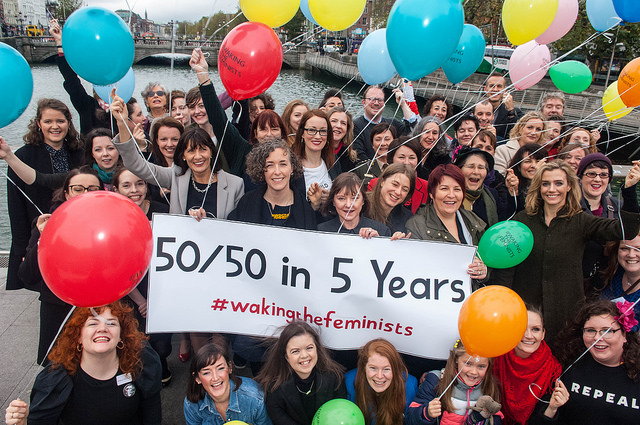
 

wtf.jpg

Photo by Kate Horgan


“This is what collaborative feminist power looks like and it is a powerful, playful and inclusive thing.”

In just one sentence Sarah Durcan, general manager of Science Gallery International and member of the Waking the Feminists group, succinctly summed up the atmosphere in the Abbey Theatre today at Waking The Feminists’ One Thing More.

On October 28th 2015, the Abbey Theatre launched its 2016 programme marking the centenary of the 1916 Rising, a programme which featured only one play written by a woman, and only three directed by women. In no time Ireland’s feminist alarm clock, Lian Bell, had posted her now famous Facebook post highlighting the issue of gender imbalance, not just in the Abbey, but across the sector, and the wheels were in motion. Just two weeks later, the first Waking the Feminists meeting took to the Abbey stage, kicking off what was to be one of most active years of evolution and change in Irish Theatre in over a century.

Today, Waking the Feminists filled the Abbey Theatre for their final event, One Thing More. The aim of today’s event was to take stock of the year that was, and to discuss where the work of the campaign could lead in the future. With too many speakers to reference individually, dozens of diverse voices said their one thing more about Waking the Feminists.  Young, old, Irish, American, English, Welsh, Scottish, men, women, writers, producers, managers, actors, people from every corner of the sector and beyond added their voices to the discussion. Our new directors of the Abbey Theatre, Neil Murray and Graham McLaren, offered an open call for everyone’s “outrageous,” reminding us that “regardless of race, gender, age, or the money in your pocket, the Abbey is your theatre” and re-iterating that the National Theatre exists to serve, not be served.  Later, Amelie Metcalfe, the youngest speaker at only eight years old, told the audience of the reasons she is proud to  be a girl in Irish theatre, but asked when it was going to “wake up to children” appealing to her adult colleagues with the words “Excite us. Inspire us.” From a child then on to a parent, Tara Derrington of “Mothers Artists Makers” (M.A.Ms) spoke of their work over the past year, and of their continued aim to highlight the unequal care burden that is pushing many mothers out of careers in the arts.

Not only were there speeches in person on the stage; a number of supporters sent video messages to be played as part of the proceedings. Emma Rice, former artistic director of The Globe, took to the screen to much applause as she asserted that “we need to make our presence felt at every level.” With one speaker just off the plane from America, another a long-time emigrant returned to Ireland, another sharing her experiences of theatre in Poland, messages from England, America, and across Ireland streaming in, and a wealth of passionate voices both on and off the stage, there was a tangibly electric and powerful atmosphere throughout the venue. Orlaith McBride, director of the Arts Council, said that Waking the Feminists is “a perpetual flame, it is a fire that will not go out,” and the energy in the Abbey mirrored that.

Towards the end of the morning, the research group from NUIG who compiled a study of gender equality in Irish theatre over the past decade presented a number of their findings, sending a cacophony of gasps and sighs rippling through the auditorium. The full report is due to be published in early 2017, but even today’s snapshot painted a stark statistical picture.

As happened in 2015, with the now iconic sing-along to Aretha Franklin’s “Respect,” the meeting ended on a song. Camille O’Sullivan sang the event to a close with her rendition of Leonard Cohen’s “Anthem,” bringing many to tears and all to their feet by the time she sang the final lines.

Waking the Feminists has been an historical moment in Irish theatre, and One Thing More was a fitting end to it. To borrow a quote from Jane Daly, “to do nothing is simply not an option.”
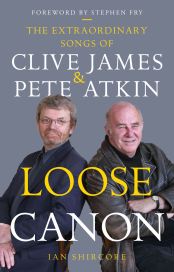
Loose Canon – Book Review

Loose Canon: The Extraordinary Songs of Clive James & Pete Atkin

Ian Shirocore

Red Door Publishing, 2016

loosecanoncover815x1276

“The common characteristic of all Atkins/James songs is that they don’t sound like each other, and they don’t sound like anything else.”

The appeal of Ian Shircore’s book Loose Canon: The Extraordinary Songs of Clive James & Pete Atkin, is best summed up in this line from chapter 17. It is a celebration of the diverse and accomplished careers of Clive James and Pete Atkin, as well as an exploration of how their collaborative work came to be what it is.

Blending technical analysis of songs with entertaining personal anecdotes, Shircore writes a book that is an interesting and entertaining read for both the casual and the devoted listener. While it is definitely aimed at an audience of long-time Atkin and James fans, fans who were listening through the duo’s most active years in the 1970s, this is by no means alienating or limiting. I, a twenty year-old listener of Atkin and James’, felt welcomed into the book with open arms.

Even in the most densely factual and analytical passages, Shircore writes with flair. Making liberal use of metaphor and lyrical images of his own, with a description of James’ writing in Have You Got a Biro I can Borrow as a “dancing constellation of internal rhymes” standing out as a particular example of this, Shircore mirrors James’ own tendency to marry technical particularity with natural flair. The information about James and Atkin, beyond their work, that is woven through the exploration of a selection of their songs adds depth to the discussion of their work and gives an insight into the artists as people.

Shircore writes with an easy, open style that makes this book an accessible and engaging read. This casual tone can, at times, lead to some repetition which takes some chapters on a circuitous route to their point, and to sweeping statements which can err on the side of hyperbole in the case of lines such as the one in which “Together at Last” is described as featuring “the most spectacular enjambment ever.” However, overall it is one of the strongest features of the book, opening the doors and leading the reader through an exploration of James and Atkin’s varied and fascinating careers with ease.

Loose Canon takes an engaging and insightful look at the careers of Clive James and Pete Atkin through a close examination of a selection of their extensive songbook. It is a book to be read whilst listening to the songs it discusses; between the writing of Shircore, James and Atkin, “the music in the room, both beautiful and true, on plushly hushed extended wings, is flown to me and you.”

Butterflies and Bones – Review

Originally published on The Reviews Hub

Butterflies and Bones

Project Arts Centre, Dublin

20/10/16

butterfliesandbones_pac-e1477088990763

In recent months, Irish stages have been awash with productions exploring 1916 and where we stand on the events of that year now, in 2016, a hundred years later. There have been productions about the Easter Rising, productions about the creation of the state we live in now, and productions about Roger Casement. As one might imagine, after nine months of this, the theme is getting worn and fewer avenues are left to be discovered. However, Butterflies and Bones: The Casement Project, created by Fearghus Ó Conchúir as part of Project Arts Centre’s 50th anniversary programme, puts paid to any such ideas of staleness. An electric and insightful work, Butterflies and Bones conveys the human behind the history with skill and passion.

Roger Casement (formerly Sir Roger Casement; he was stripped of his title before his execution for his involvement in Irish revolutionary activity, including the 1916 Rising) was a British peer, and Irish nationalist figure and all-round enigmatic historical figure. However, alongside his political life, there is his personal life. As a gay man in early 20th century Ireland, Casement had a carefully hidden portion of himself that was only later discovered in a number of diaries. Butterflies and Bones effectively reminds the audience of this; that Casement was not just a political or revolutionary figure, but a person too.

Ó Conchúir’s choreography (created in conjunction with the performers) is evocative and intense, conveying the formal public Roger Casement, and the raw, open private Casement. Introducing strong elements of each performer’s personal dance style into the performance, and then creating segments in which they adopt each others’ movements, the choreography creates a strong ensemble that portrays Roger Casement as a multi-faceted character. One of the most powerful elements of this, when combined with Alma Kelliher’s expressive sound design, comes through in the undercurrent of fear and threat portrayed almost throughout the performance. Even in moments of heady ecstasy, there is a threat lingering in the atmosphere, whether of being discovered in his republican activities or in his personal life.

Working with dance styles reminiscent of those such as Lucinda Childs’ 1970s/1980s postmodern choreography, The Casement Project takes the theme of 1916/2016 far from any danger of nostalgia or stasis and injects it with a revolutionary quality of its own. As it breaks down, reforms and plays with a tower of speakers and two large metallic cloths (the only props), this production breaks down and represents a well known historical figure in a new and insightful light. Complimenting this performance and direction style, Ciaran O’Melia’s skilful design, both in terms of lighting and set, takes the piece far from the reach of realism and into an exciting, open and productive space.

Butterflies and Bones: The Casement Project takes a well-worn topic and re-invigorates it in innovative and engaging ways. With a wealth of dramatic, political and social history to absorb and re-invent with ingenuity and fervour, this production takes a truly new approach to the story of Roger Casement and 1916.

trhlogo