Review: Fantastically Great Women Who Changed the World

Wales Millennium Centre

Cardiff

18/01/2024

Photo Credit: Pamela Raith

“It’s Marie Curie!”

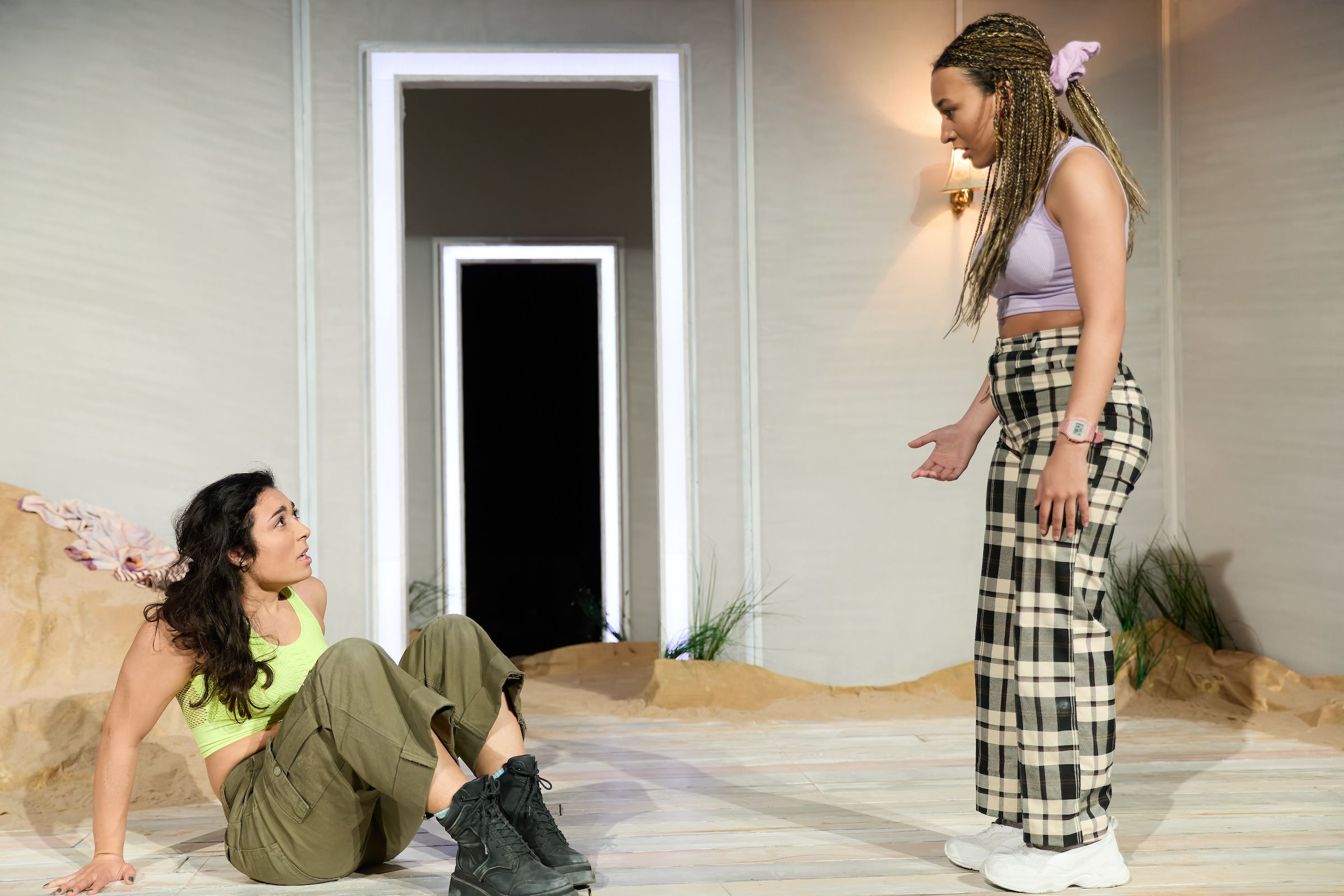
A small girl’s voice ringing out across the auditorium in delight as she sees one of her heroes represented on stage sums up Fantastically Great Women Who Changed the World. Adapted by Chris Bush from the picture book of the same name by Kate Pankhurst, this is a show that celebrates women past, present and future.

Introducing a variety of historical figures, such as Amelia Earhart, Frida Kahlo, Gertrude Ederle, Emmeline Pankhurst and Sacagawea, this whistle-stop tour of women’s history is carried on a score of upbeat pop songs as each woman tells their story. The recipient of these stories is Jade, a young girl who has strayed from her school tour group and found herself in the off-limits Gallery of Greatness. Finding herself in trouble as a result of the unseen labour she took on to care for her classmates, and questioning why she doesn’t get a say in decisions in her life, Jade is the perfect character to ask the right questions and demonstrate the importance of having role models you can recognize yourself in.

Though the show feels, at times, like it has tried to cram a little too much into its 80 minutes, dashing through depictions of women in history and bringing in questions about Jade’s parents’ divorce that it doesn’t quite manage to address, it is a joyful celebration of women’s achievements that is sure to leave audiences buoyed and reminded of their own power. In its staging as well as its story, Fantastically Great Women Who Changed the World forefronts women, from quite literally highlighting a kick-ass drum solo and spelling out references to contemporary icons with Joanna Scotcher’s colourful neon light-box set, to the captivating on stage BSL interpretation.

Reminding us that we “stand in the spot carved out by the women before us,” Fantastically Great Women Who Changed the World” is an uplifting and engaging family show that provides a memorable introduction to intersectional feminism and women’s history.

Fantastically Great Women Who Changed the World runs at Wales Millennium Centre until 21st January 2024, before continuing its tour.

Review: A Queer Collision

Three people stand in a row. The first is an older man, in his sixties, wearing a mint green jacket and grey pullover, dancing with his arms above his head. The second is a younger man, early forties, wearing a blue jacket and dancing side on to the camera, arms outstretched. The third is a black woman wearing a silver sequinned dress and bright coral red lipstick, palms held to her chest as she appears to sing.

Royal Welsh College of Music and Drama, 18th November 2023

It is hard to find a succinct description of the evening that was A Queer Collision at Royal Welsh College of Music and Drama. Opening with cabaret performances from VIP (Very Important/Visually Impaired Person) Ebony Rose Dark and dance artist Rajan Das, leading into the main show with Willie Elliot and Stuart Waters, and closing with a sparkling turn by drag artist Venetia Blind, A Queer Collision was an act of celebration, commemoration and storytelling that spanned the personal, historical and political. 

Ebony Rose Dark and Rajan Das provided two contrasting cabaret acts to kick off the evening in the foyer, with Ebony Rose Dark delivering classic diva numbers with an effortless sense of glamorous joy, and Rajan Das performing a seductive, self-reflective movement and spoken word act. Using the closing moments of his act to invite the audience into the auditorium, Das set the stage for the direct, pared back approach of the main show. 

Immediately breaking the fourth wall to introduce himself, the BSL interpreter and the in-house counsellor, Willie Elliot holds the role of storied elder on the stage, telling stories that span his 65 years from cottaging at Buchanan bus station to watching Section 28 and the AIDs crisis hit his community, to attending his first same-sex civil partnership ceremony. 

His is a wise and silly character, held in balance by Stuart Waters’ younger, sometimes more intense character. 

The show employs a wide ranging arsenal of theatrical devices to tell its stories, with some proving more successful than others. The inclusion of audio description as an embedded feature of the script was a brilliant innovation and, while I can’t compare it to standard audio description as I have never had call to avail of it, it felt like an effective device. 

Within the sparse, bare stage, the inclusion of movement enhanced the storytelling at several points throughout the show, a section about all the different ‘types’ of men, a mincing military parade laying bare the farce of describing allowing gay men to join the army as progress, a depiction of a dance show rife with agonising second-hand mortification, a harrowing assault, and an absorbing memory of early encounters at a disco. However, there were also moments in which movement sequences happening adjacent to a spoken story felt extraneous and distracting. In these moments, leaning into the simplicity of the stage would have held a stronger space for the stories being told. 

Though at times the pacing was a little disjointed, with some episodes that would have benefited from being trimmed or placed at different points in the show, overall A Queer Collision was an absorbing work that presented its audience with both comforting resonances and opportunities to learn. 

The final word in this review has to go to Venetia Blind, who closed out the evening with two incisive and hilarious numbers about inspiration porn and consent. The highlight of my evening, she brought vivid wit and cheeky humour to her musical commentary on common problems. 

A heart-warming and heart-wrenching evening of entertainment, stories and histories, A Queer Collision is worth catching as it continues its UK tour. 

Review: Imrie

Sherman Theatre

Cardiff

16/05/23

Bodoli, to exist. Something we take for granted, something we do every day. But to exist as yourself, to find a place where you can be, can exist as your true self, is another matter.

In Imrie we meet two sisters, Josie and Laura. Neither fits in, each is in her own way on the margins. Opening with a Friday night party on the beach, Laura tries to find her way into the popular crowd in school but, as a mixed race girl in an exclusionary, predominantly white, space she finds herself “in the middle but still on the sides.” Josie, on the other hand, does not want to venture into the centre of the group and instead remains on the fringes, distanced from the group. That is, until she finds the spotlight painfully thrown upon her and flees the scene, running away to the water’s edge.

It is at this point that the magic realism of this work comes into play, as Josie meets the enigmatic Imrie and discovers an underwater world, finding herself invited to a magical party populated by people like her, a place where she can fit in. In this absorbing coming of age tale, Josie and Laura learn valuable lessons about identity and community.

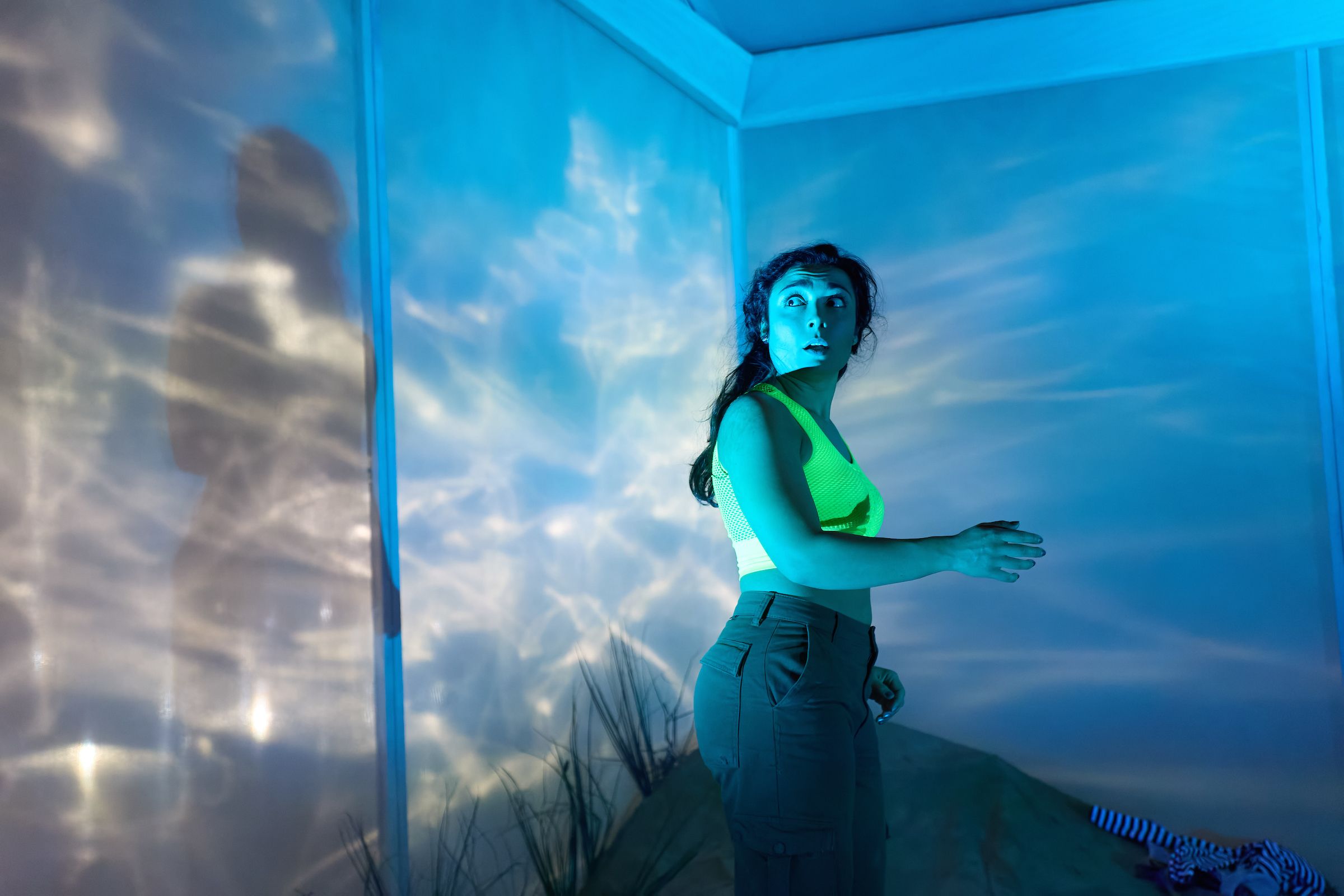
The world of clique-y teenage social groups is one familiar to many of us. The underwater world of sirens, less so. But Morais’ writing coupled with Ceri James’ simple but dynamic lighting design draws the audience into both worlds with ease. James’ use of contrasting palettes and movement to distinguish between worlds within Cai Dyfan’s sleek, pared-back set is smart and effective. Rippling colours, bright shaping lines and UV light conjure the magical new place in which Josie discovers her identity, while sharp returns to a stark white box jolts us back to earth, and these distinctions gradually blur and become more fluid as the story evolves.

Under Gethin Evans’ direction, Rebecca Wilson as Josie and Elan Davies as Laura both deliver strong performances, deftly holding the space through pensive monologues and portraying a convincing sisterly relationship through their dialogue. Each portrays a balance of vulnerability and growth that provokes a feeling in the audience of being an older sister, who wants to reach out and guide the characters safely through the unsettled waters of self-discovery.

A captivating meditation on sisterhood and the sidelines, Imrie is a must-watch for anyone, teen or adult, who has ever struggled to fit in and find their place.

Imrie runs at the Sherman Theatre until 20th May before touring Wales until the 16th June.

Comic Relief

Originally published on http://www.takeyourseats.ie

If you happened to look online in the last few days, you may have incredulously read some very strange announcements, from swimming clubs reporting giant squid in their usual haunts, to brands launching some bizarre new products. Yes, it was April Fools’ Day. A day eagerly anticipated by pranksters, and a day for the more gullible among us (myself included) to be on our guard.

We don’t know the true origin of April Fools’ Day; suggestions have ranged from the Edict of Roussillon which changed the date of the New Year from Easter to January 1st during the reign of Charles IX of France, to confusion with the changeable weather around the Equinox. I know I certainly have been caught as a fool a few times in recent weeks, prematurely switching to a lighter jacket in a fit of vernal optimism! However this particular holiday began, we do know that such celebrations have existed for centuries across various cultures. Which is why I am being deathly serious when I tell you, be silly.

Be daft.

Have a laugh.

Be silly.

Life provides us with many reasons to be serious, more reasons than we would like to have. So when we have the option, let’s not add more to the list. No matter how serious life becomes around us, we all need a light-hearted reprieve to balance things out. Just think of any of the great theatrical tragedies; even as things are falling to dust and disaster around the central characters, the writer will add in a dash of comic relief, knowing that their audience cannot bear truly relentless tragedy laid across the stage in front of them.

Just as Hamlet needs the interlude of the gravediggers to alleviate the tension of the play and pace the drama, so too do we need to pace ourselves. On a global scale, life is pretty tough at the moment. Where we can, it’s important to find and allow for moments of respite.

And theatre is one of the best places to find that. Every raucous communal laugh, every jaunty major chord, every mischievous glance between audience and performer makes someone’s life a little better. Entertainment for entertainment’s sake lights up our lives, and that happiness is contagious. Even when we leave the theatre we hold on to some of that brightness, that positivity and we share it, even unconsciously, we pass that light on to other people and that is a powerful and necessary thing in life.

As Bertolt Brecht put it in A Short Organum for the Theatre, ‘Since time immemorial, the theatre’s business has been to entertain people, just like all the other arts. This business always gives it its particular dignity; it needs no other passport than fun.’ Whether it is in the form of a comedy night, like Stand Up Comedy Sunday at the Viking Theatre, a family day out to enjoy a feast of musical curiosity and invention in Wires, Strings and Other Things at the Ark, or a humorous, joyful and gentle dismantling of stereotypes and expectations in Silvia Gribaudi’s work Graces at Dublin Dance Festival, if you are booking yourself a ticket to see something this month, make space for delight.

Bread & Roses

Originally published on http://www.takeyourseats.ie

It feels a little strange to be trying to write about theatre with everything that is going on in the world at the moment. As we read stories of lives being destroyed in Ukraine, I find myself wondering what I could write here that would justify being read amongst that news – writing recommendations of shows to go see feels somehow flippant. But maybe it is in these moments that we need things like theatre more than ever. In the face of the inhumanity of leaders like Putin, it becomes all the more important that the rest of us embrace and enact our own humanity, and gathering together to experience art collectively can play a part in that.

This coming together can be enacted both on and off stage in many ways. Offstage, we can take political and social responsibility and make a difference. This week, a huge number of European theatre networks, joining together venues, theatre companies and individuals, have pledged to support Ukrainian artists and to host events in support of the country. By choosing where we put our money, and how we utilise our spaces, we can help those who need it. Venue programmers can choose to support and platform Ukrainian artists, but audiences can do their bit too. Perhaps when you go to see a show this weekend, instead of buying an interval drink put that money towards aid to Ukraine, either through charities or by donating goods to any of the many local collection drives around the country.

On stage, we can platform unheard voices, we can question the status quo, and we can engage with people who have been otherwise kept on the margins. From Ancient Greek theatre platforming the political debates of the day, to Augusto Boal’s Forum Theatre, to the work of organisations like The Freedom Theatre in Palestine today, art has always been utilised to effect political change. Where people gather and have the freedom to make their voices heard and hear their stories told, a positive change is always possible. Yes, practicalities of food, shelter, medical care and other needs must be met, but souls need to be nourished too. Reading the ongoing series of letters from political prisoners in Belarus that the Belarus Free Theatre publish, there is, of course, a lot of discussion of the practical and emotional hardships of life in imprisonment but almost every letter references art in some way too, whether it is lines quoted from a poem, opinions on music shared, or meditations on how painting and drawing has helped them to process their experiences. Even in such awful situations, the impulse is there to reach out to others and share art and its effects. That instinct is deep rooted in humanity.

Any way in which we can draw people together to share their time and experiences can have a positive effect, whether that is through a theatre workshop, a food drive at your local community hall, or laughing and crying collectively at a performance. So this month I am not recommending any particular shows, but instead I ask that you take the generosity at the heart of the arts and play your part in spreading care and support where it is needed. People need refuge and supplies, but they also need hope, and love and care – as the song goes, ‘hearts starve as well as bodies, give us bread but give us roses.’ Reach out to others with open arms and share what you have in whatever way you can.

Review: Finding Home

Mercury Theatre

DEPOT Cardiff

11/10/21

Image: Jorge Lizalde

Taking place in the cavernous warehouse venue, DEPOT, Finding Home is an affecting and powerful piece of theatre exploring stories of homelessness. Framed by a fictional memorial service for those who died while homeless, Finding Home tells the story of a varied group of characters who find themselves thrown together into a makeshift family, as they face the challenges and hardship of life without a home.

Megan, Cobbit, Bagsy and Lola make an unlikely family, but in each other and in “Hafan,” the derelict office block they occupy, they find some refuge from their individual struggles. But plagued by shellshock, alcoholism, mental health issues, grief and fear, each character is pushed to their limits, and through these central stories and those of side characters, the audience sees how different those individual limits can look.

Nick Hywell, Bethan Morgan, Sarah Pugh and Elin Phillips all deliver strong performances as central characters in the play, but it is Gethin Alderman that stands out as Bagsy. “A missing person who doesn’t want to be found,” Alderman’s Bagsy is a heart-wrenching character who teeters on a sheer precipice as he tries to soothe his mental and emotional hurt by cooking for his friends. In a striking ensemble dance sequence, Bagsy’s agonising tipping point is sensitively and powerfully portrayed by the core cast and the chorus comprised of performers from Hijinx Theatre, Oasis Refugee Centre and Emmaus South Wales.

With its dance elements, heartbreaking musical interludes, beautifully integrated BSL interpretation, and pre-show exhibition and performances, Finding Home brings together numerous threads to weave an absorbing tale. Carl Davies’ design and Jorge Lizalde’s projections surround the audience, who are seated on two sides of the playing space, creating a sense of immersion in the world of the characters, and bringing a sense of realism to what is an intensely theatrical work. An expansive production, Finding Home explores an enormous topic through intimate, personal stories, drawing its audience into the realities of homelessness through deft theatrical storytelling.

Review: Aalaapi

La Messe Basse

Assembly Showcatcher

Edinburgh Festival Fringe

“It is a kind of expression to be silent because what we are hearing is beautiful.”

Aalaapi is a layered online theatre work, combining a radio documentary in which five young Inuit women speak about their lives, and the on-stage production in which two other Inuit women, Nancy Saunders and Ulivia Uviluk, listen to the radio documentary. As the audience watches these women through the small window in their house on stage, they are given a window into Inuit culture, and the lives of women living within it.

Directed by Laurence Dauphinais, Aalapi uses the radio as it’s centre point, grounding the rest of the activity on stage around it. For the majority of the show, the audience only sees the performers through the small frame of the window, but the radio is always present as a centrepiece of the household and an important cultural object in Nordic communities. Layering the trilingual soundscape of the radio documentary with the chat of the women on stage, Inuit throat singing, the ever-present sounds of the landscape, and beautiful informative projections of words, maps and landscapes animated by Camille Monette-Dubeau, Aalaapi immerses its audience in Inuit culture for 80 minutes, at first in the position of outside onlooker, and by the end as a welcomed visitor.

This is not a fast paced plot-driven show, it simply invites its audience to sit, listen and consider. It is poetic and meditative, taking on the pace of a long dark winter evening spent in cosy familiar company. Though the information it shares through its documentary elements is important to share, the truly striking feature of Aalaapi is this slow, naturalistic pace. The act of having two women on stage just chatting, living and listening to the voices of other indigenous women on the radio feels gently radical. There is no need for the idealised strong female lead in this play, because it celebrates the reality of women who are allowed space to be both strong and vulnerable in turn, who don’t have to do something extraordinary to be seen. It makes space for the real day-to-day lives of women to be represented.

Constructed with skill and ingenuity, Aalaapi is an absorbing and immersive piece of documentary theatre which demonstrates the true power of representation on stage. La Messe Basse have created an extraordinary work about ordinary lives.

Aalaapi is available to stream on demand via Assembly Showcatcher until 30th August as part of the Edinburgh Festival Fringe.

Review: Metamorphosis

Hijinx

Edinburgh Festival Fringe

Summerhall Online

25/08/21

What do you have in common with a ‘monstrous verminous bug?’

Before you indignantly shriek “Nothing at all! How dare you!?” and slam whatever device you are reading this on down and storm away insulted by the question, prepare yourself for worse – you may have more in common with it than you think.

Taking Kafka’s classic story of travelling salesman, Gregor Samsa, who finds himself transformed into some form of horrifying vermin and remains trapped on his back in his room as his family and colleagues live their lives around him, Hijinx take an inventive and entertaining look at parallels between the original text and the transformation we all underwent during Covid-19 lockdowns.

From a hilarious remote audition process, in which Lindsay Foster and her ring light momentarily steal the show, and directionless break-out room rehearsals to performance, the cast present a Zoom-play within a Zoom-play. As they prepare to present this play, it becomes clear that all is not right, and life begins to mirror fiction, with unsettling messages in the chat, flickers and cuts to characters seemingly undergoing transformations, and domestic spaces unsettled.

Punctuating and framing this story within a story, is the Kaf Bar, where the cheery barman invites the audience to chat, meditate with ‘the guru,’ enjoy a drink, and respond to existential polls. This is set as a friendly space outside the action of the place, but the changes of the play soon impinge on this space too, and like in other moments, the themes of Kafka’s work bleed into the ‘normal’ settings, shedding new light on the ideas of the original text.

The direction and design of the piece makes full use of the online setting, openly acknowledging the Zoom platform (and the challenges it brings) rather than pretending that it is not there. Director, Ben Pettit-Wade uses the production’s online platform to great effect in moments such as that in which a face is constructed, Frankenstein-like, from close up images of individual features of the cast, and in which the cast commit recorded faux-pas in a Zoom breakout room during rehearsal. In streaming the work live, Hijinx have also opened up a world of interactive possibilities for the audience, which are deftly handled by Owen Pugh as the Barman.

Treading the line between surreal and bizarrely real, Metamorphosis holds a theatrical mirror up to the transformations of the past year, and through laughter leads us to ask important questions about identity, care, isolation and connection.

Metamorphosis runs live at Summerhall Online until 29th August as part of the Edinburgh Festival Fringe.

Review: Fow

Deaf & Fabulous/Taking Flight

Edinburgh Festival Fringe

Summerhall Online

Almost all of the best drama in love stories boils down, in one way or another, to communication, or a lack of it – from Darcy’s ill-judged proposal, to Harry and Sally skirting around the edges of friendship for years. Fow is no different. Three characters, one speaking mainly Welsh, one using mainly British Sign Language, and one English, find their paths intersecting in unexpected ways and have to figure out how to overcome barriers in communication far beyond those posed by their respective languages.

Lissa is deaf, and the combination of living with her difficult Instagram-influencer housemate, lack of communication with her family and struggling in university has her on the defensive, so when Sîon accidentally stumbles into her life, he doesn’t get the warmest reception. However, as they spend more time together, and begin to understand each other, that changes. Throw in a surprise visit from Lissa’s chaotic older brother Josh, some spectacular arguments, and a romantic gesture that belongs in the Pantheon with John Cusack holding a boombox and Hugh Grant impersonating a member of the press, and you have all of the ingredients for a classic romantic comedy.

Though, like many other shows in the past 18-months, Fow was filmed on Zoom or a similar platform, it does not feel like it has lost theatricality in its transfer to a trio two-dimensional boxes. Using frames, backdrops, puppets and paper speech bubbles, Becky Davies’s design creates a theatrical space reminiscent of photo-story comic strips, making use of its confinement to Zoom-boxes. Such clever construction and adaptation is a hallmark of this show, with Alun Saunders’ script blending three languages to great effect and bringing the audience along on the journey of communication gaps, miscommunications and eventual understandings that the characters traverse.

The three performers, Stephanie Back, Ioan Gwyn and Jed O’Reilly, all deliver impressive and convincing performances, sustaining the energy of the work on screen for almost two hours, while never overcompensating and losing the easy, natural relatability of their characters.

Fow is a precise, insightful and entertaining play, which prompts us to question what language and love mean to us.

Fow is available to stream via Summerhall Online until 29th August as part of the Edinburgh Festival Fringe

Review: Few Are Angels

Three Chairs and a Hat

Edinburgh Festival Fringe

Online@theSpaceUK

Setting several of Shakespeare’s famous women into modern-day settings, Few Are Angels invites its audience to revisit the Bard’s female characters in a new light. Directed by Wayne T. Brown, Cleopatra sits in a dark cell, wearing a striking red dress, and performs her monologue to a CCTV camera, Helena from A Midsummer Night’s Dream finds herself on a nondescript suburban path, and Much Ado about Nothing’s  Beatrice lights up a cigarette and texts the first few lines of her dialogue.

Some texts transfer more easily into their modern settings than others. Mistress Page’s monologue lacks some of its original context, and Beatrice’s one-sided dialogue with the silent camera standing in for Benedict loses some of its meaning without Benedict’s lines. In contrast, the setting of Cressida’s monologue in the scenario of a woman on a dating site transfers easily and brings a new humour to the monologue as Cressida sits in front of her laptop in her tiger onesie with a box of chocolates and a glass of wine to hand. Similarly the Courtesan’s monologue from The Comedy of Errors fits perfectly into the setting of a neighbour in her marigolds and curlers chatting over the garden fence. Those monologues which find a foothold in the zeitgeist, whether through cultivating a garden as many of us did in lockdown, online dating, or chatting with neighbours from a distance, find the most success in their updating.

The highlight of these is certainly Julie Todd’s tear-jerking rendition of Fear no More the Heat o’ the Sun from Cymbeline. With new music composed by Nia Williams, this dirge accompanies the story of a recent widow, with a montage of scenes from her husband’s final moments as he lies in bed wearing an oxygen mask, and her gradually adjusting to an empty house. Touching on a grief that is familiar to many people in the past year, this scene stands out as a heartfelt example of how an old text can apply to new settings.

Just as the updating of Shakespeare’s text is mixed in its success, the quality of execution in the filming of the work is patchy. I found myself reaching for the remote control at the start of each monologue, having to adjust the volume between levels 5 and 20 to keep up with the unstable volume levels of the work. Though the monologues have clearly been directed and performed with filming in mind, the technical quality means that the work feel uncomfortable in its digital setting, leaving its audience with the feeling that they have not seen it to its full potential.

Bringing these characters, who would originally have been written to be played by young men, into the present day played by a large cast of women, Few Are Angels begins with a strong concept, though stumbles in its adaptation and digital execution.

Few Are Angels is available to stream on-demand until 29th August.