Running With Dinosaurs – Review

The New Theatre

19/04/17


dino

Image: Bill Woodland


Written by Nadine Flynn, Running With Dinosaurs is a moving  story of a family in crisis that takes an honest look at the effects of gang culture and financial difficulty. Jay is in his early twenties and is trying to find his way in the world and get a job, his sister Siobhan is traversing the ups and downs of her first relationship, and Sammy is seventeen and an aspiring musician who just wants to keep his head down. Add into the mix their grandfather Frank, who has recently moved to a nursing home, their mother who is slipping back into an alcohol addiction and Siobhan’s questionable choice of boyfriend, and you have the full complement of family drama.

Though the story is well constructed, entertaining and thought-provoking, the writing can at times be laboured, with certain lines seeming unnatural in their placement or phrasing.  This is particularly noticeable in the characters of Deco (Rory Dignam) and Frank (Tom Leavey), who are hesitant or stilted when delivering certain lines. However, despite this, the cast deliver good performances, with Daniel Monaghan standing out as particularly impressive in the role of Jay. Monaghan captured the full range of the character, blending sharp comic timing with a strong, affecting performance of the difficult situations Jay finds himself in,

Lee Wilson’s direction excellently draws out the layers in the story and makes the most of the stage space in portraying them. Particularly notable is the overlapping of scenes, with one scene beginning downstage as another is ending or silently being played out upstage. This is complimented by Bill Woodland’s lighting design which efficiently directs the focus of the audience to the main scene.

Running With Dinosaurs, though at some points a little stilted, is an engaging show that takes a raw look at what it is like to traverse the transition to adulthood in a disadvantaged area rife with gang culture.


Runs at The New Theatre until 29th April.
The Last Days of Cleopatra – Review

The New Theatre

22/3/17

Note: This is a review of a preview performance.

cleo

“Sure that’s what you’re up against.”

Telling the story of a family living through the death of their mother, Laoisa Sexton’s The Last Days of Cleopatra is heartbreaking and hopeful, bringing the audience into the lives of Jackey, Natalie, and their father, Harry, as they face the slow death of Jackey and Natalie’s mother, and  make their way through difficulty, difference and hurt

Directed by Alan King, this production tackles sensitive and difficult topics with a blend of humour and care. The combination of King’s direction and Sexton’s writing makes this a powerfully real engagement between characters and audience; the focus is clearly on the development of each character throughout.  The interlocking lives of the family members overlap and intersect, sometimes comfortably, sometimes in more challenging ways, but always with an insightful exploration of the context and consequences of various events and interactions. Through recurrent motifs in the dialogue, a sense of painful repetition is created, suggesting an almost inescapable cycle of difficulty for the family. However, this is finely developed and if one looks, one can find the gaps in the cycle, the chances for hope.

This is impressively performed by cast Gerard Adlum, Ger Carey, Ruaidhri Conroy and Laoisa Sexton, who all convey the depth and humanity of their characters with skill. Particularly note-worthy was Sexton’s performance as Natalie; when Natalie expressed an emotion, the audience had little choice but to join her in it. These strong performances are enhanced by Eamon Fox’s effective and evocative lighting design which provides impressive depth to a small stage.

The Last Days of Cleopatra is an excellent production that unflinchingly looks into the highs and lows of a struggling family, and in doing so brings the audience and characters on a journey that reflects the best and worst we can be and challenges any settling or stagnation of our outlook on life.

The Last Days of Cleopatra runs until April 1st at The New Theatre, Temple Bar.

Scene and Heard – May I Use The Bathroom Please/Mic Drop

May I Use the Bathroom Please?

May-I-Use-the-Bathroom-e1483986334522.jpg

Written and directed by Johnny Walsh, May I Use the Bathroom Please?  has many of the elements of a successful comedy, however, in 30 minutes it does not make the most of this potential. The escalation of tension and energy in the piece is uneven and rushed, with too many plot twists crammed in to a short space of time.  Set in a dingy bar in Dublin that suffers from a lack of customers (but which will not suffer the arrival of any newcomers), May I Use the Bathroom Please? is a farcical comedy about a St Patrick’s Day like no other. The performers all delivered energetic performances, but consistently stood outside their light and struggled at moments with timing of lines. Though the story, if developed further, has the potential to be a strong farce, there is a rushed, haphazard feeling about much of the writing and the execution of the piece.

Mic Drop

mic-e1484043789453.jpg

Perry Pardo, a successful and wealthy internet entrepreneur, takes to the stage to teach his audience the secrets of success in a digital age and to tell them how he made his fortune, having started in the streets (like Dre, he reminds us). Written by Gareth Stack and performed by Adam Tyrell,  Mic Drop is an entertaining piece of theatre, that shows two sides of fame, and questions the idea of success. Pardo made his fortune, but at what cost? As he snorts coke, checks his tinder on stage, almost breaks down repeatedly and loses himself in angry tangents, Pardo is a character who is self destructing in pursuit of success. Though the character holds great potential, it is sometimes unclear exactly what the production is commenting on; has Pardo been broken by a dog-eat-dog individualist society, is it just heartbreak to blame for his behaviour, or are both these things, and more, feeding in to each other? There are some cracks in the overall arc of the production, but it is a piece that, with some clarification of ideas, has great potential for development.

Scene and Heard – Owned/Syrius

Owned

owned-e1483986106579

Exploring the slave trade, from its pre-civil war American history to the current realities of the use of slavery in production of most of what we consume, from Nestle cereals to Gap hoodies, Syrius is a strong piece of theatre that challenges its audience. The work blends text with movement, with each ensemble member bringing a distinct but complementary style to the piece. The piece is, at times, somewhat disjointed, with the text coming across as a talk or lecture rather than a theatre piece, but it is still effective in conveying its message. In breaking the fourth wall in a number of ways, and encouraging the audience to look up www.slaveryfootprint.org, the performers push the audience to truly engage with the subject matter. Owned, directed by Ailish Leavy is an engaging and confident production that highlights an important global issue.

Syrius

syrius

Written and performed by Romana Testasecca, with direction by Karen Killeen, Syrius is a powerful piece of theatre exploring the experience of one woman who travelled from Syria to Portlaoise as a refugee.  The powerful movement in the work, choreographed by Stefanie Dufrense, portrays the many difficulties faced by the character, from her initial defiance against the military presence in Syria, to her journey to Ireland. Testasecca has an impressive presence on stage, drawing the audience into the story and creating a pulsing vein of hope throughout the piece.

Efficacy 84 – Review

Samuel Beckett Theatre, TCD

TCD Drama Department Devising Debut Festival

16.7.17

efficacy.jpg

Taking the 1984 Kerry Babies Case, in which the body of a baby was found on Cahirciveen beach, and another buried on a local farm, leading to an investigation that was fraught with issues around Garda conduct and veracity of information, as inspiration, Efficacy 84 is a heartbreaking piece of theatre that examines the society in which such an event could occur. This work, devised by Luke Casserly is an insightful exploration of a personal and public story.

Using effective distancing techniques, including microphones and the blurring between actors and characters, the piece recreates a sense of distance from the people involved, such as Joanne Hayes who was suspected of killing the children. As the piece develops the audience gradually realises the effect of this separation from the characters as people; the investigation clung to Joanne Hayes for so long despite scientific evidence to contradict suspicion against her because investigators saw her as an example rather than a person. She was not just Joanne Hayes; she was a woman caught between the Old and New Ireland, a woman who, for some people, embodied the change that was taking place in the country. It is easy to let injustices slip by when the victim is not recognised as a person, when a connection is not made with them. The framing of the piece, with Casserly joining the cast on stage and directly addressing the audience, combined with highly stylised performance, brings this to life and puts the audience in a position whereby they are engaged in the act of distancing.

The performances are consistently strong, with the actors finding a balance between levity and intensity under Casserly’s direction. Lisa Nally delivers an open, powerful performance as Joanne Hayes, and the entire cast operates as an impressively connected ensemble.

The design of the piece also plays a large part in the distancing discussed earlier, with Sorcha Flanagan’s costume design standing out as a particular example. By dressing the female actors in simple floral dresses and plain brogues and the only male actor, Simon Geaney in a classic shirt and jumper, Flanagan suggests a sense of timelessness of the story – this is based on a story from 1984, but it is just one example of the effects of a long-held mindset in Ireland. Benedict Esdale, as the pianist, is dressed in a luxurious velvet jacket, suggesting the conscious theatricality of the piece.

This combination of many small details makes Efficacy 84 a strong, well-rounded, affecting piece of theatre that confidently involves its audience in its development.


Danse, Morob – Review

Project Arts Centre

17/1/17

Originally published on The Reviews Hub

morob

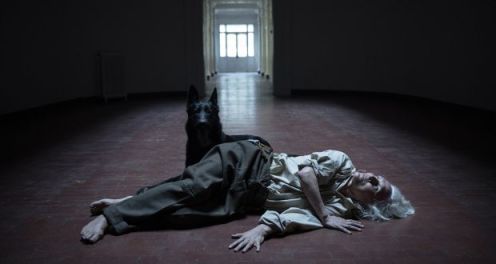
The daughter of Morob is trying to find him. Upon learning that his body is missing from its grave, she sets out with her pack of dogs to find the Long Kesh ex-political prisoner.  However, it soon transpires that this magic-realist play is about much more than just the recovery of the corpse, it is about a woman coming to an understanding of the death of her father and finding Morob, the person rather than Morob, the corpse.

The piece opens with a strong physical segment, moving quickly from the slow pre-set movement around the set and building to an intense combat between performers in which words and movement clash with breathtaking results. However, this level of interplay between text and physicality is not sustained and such choreography is used less as the text takes over.  This detracts somewhat from the energy and power of the piece, as lengthy monologues lose themselves at points and go for more where less may have been more effective. The repeated motifs in the text, a technique that one would recognise from other Emergency Room works such as riverrrun, do not carry the text forward in the way one might expect, instead slowing the pacing and giving the text a static quality at times. Even though the lead role is powerfully performed by Olwen Fouéré, whose voice could command the attention of a theatre even if she was only reading a shopping list or telephone directory, the text seems to weigh the performance down.

Despite this, there were many interesting questions raised alongside the central father/daughter story. There were questions of connection and communication brought to the fore in interactions between the characters during the seated monologues, and in the sense of self interrogation in many of Fouéré’s pieces. This also leads to contemplation of questions of identity – to what extent is the lead character defined in relationship to Morob? How much does she define herself along that plane? This is developed as the narration moves from first person to second and third. The detachment of the use of the third person towards the end conveys a strong message about Fouéré’s character’s identity as the Daughter of Morob.

The daughter of Morob appears to be a prisoner herself (though why or to whom we cannot be sure), and this is conveyed effectively through Molly O’Cathain’s costumes which are created with an excellently balanced colour-palette that compliments and is complimented by Sinéad Wallace’s striking lighting design. Wallace’s design subtly suggests the opposition between the clear-cut lines of the place versus the hazy or murky internal experience of Fouéré’s character. José Miguel Jimenez and Luca Truffarelli’s AV elements create intense experiences of the search for Morob, but the fact that they are projected behind the characters and, along with Wallace’s lighting design, disrupts the sense of space and gives the audience the impression that they are experiencing the internal world of Fouéré’s character. One gets the impression that the daughter’s search for Morob may actually have taken place in one room, in one space.  It is, as mentioned before, not just a physical search, but journey to finding an understanding of Morob and his death.

Danse, Morob is a visually stunning production that is hindered by a stilted text.

Danse, Morob runs at Project Arts Centre until January 28th 2017.


trhlogo


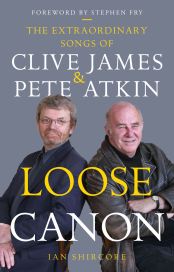
Loose Canon – Book Review

Loose Canon: The Extraordinary Songs of Clive James & Pete Atkin

Ian Shirocore

Red Door Publishing, 2016

loosecanoncover815x1276

“The common characteristic of all Atkins/James songs is that they don’t sound like each other, and they don’t sound like anything else.”

The appeal of Ian Shircore’s book Loose Canon: The Extraordinary Songs of Clive James & Pete Atkin, is best summed up in this line from chapter 17. It is a celebration of the diverse and accomplished careers of Clive James and Pete Atkin, as well as an exploration of how their collaborative work came to be what it is.

Blending technical analysis of songs with entertaining personal anecdotes, Shircore writes a book that is an interesting and entertaining read for both the casual and the devoted listener. While it is definitely aimed at an audience of long-time Atkin and James fans, fans who were listening through the duo’s most active years in the 1970s, this is by no means alienating or limiting. I, a twenty year-old listener of Atkin and James’, felt welcomed into the book with open arms.

Even in the most densely factual and analytical passages, Shircore writes with flair. Making liberal use of metaphor and lyrical images of his own, with a description of James’ writing in Have You Got a Biro I can Borrow as a “dancing constellation of internal rhymes” standing out as a particular example of this, Shircore mirrors James’ own tendency to marry technical particularity with natural flair. The information about James and Atkin, beyond their work, that is woven through the exploration of a selection of their songs adds depth to the discussion of their work and gives an insight into the artists as people.

Shircore writes with an easy, open style that makes this book an accessible and engaging read. This casual tone can, at times, lead to some repetition which takes some chapters on a circuitous route to their point, and to sweeping statements which can err on the side of hyperbole in the case of lines such as the one in which “Together at Last” is described as featuring “the most spectacular enjambment ever.” However, overall it is one of the strongest features of the book, opening the doors and leading the reader through an exploration of James and Atkin’s varied and fascinating careers with ease.

Loose Canon takes an engaging and insightful look at the careers of Clive James and Pete Atkin through a close examination of a selection of their extensive songbook. It is a book to be read whilst listening to the songs it discusses; between the writing of Shircore, James and Atkin, “the music in the room, both beautiful and true, on plushly hushed extended wings, is flown to me and you.”

Butterflies and Bones – Review

Originally published on The Reviews Hub

Butterflies and Bones

Project Arts Centre, Dublin

20/10/16

butterfliesandbones_pac-e1477088990763

In recent months, Irish stages have been awash with productions exploring 1916 and where we stand on the events of that year now, in 2016, a hundred years later. There have been productions about the Easter Rising, productions about the creation of the state we live in now, and productions about Roger Casement. As one might imagine, after nine months of this, the theme is getting worn and fewer avenues are left to be discovered. However, Butterflies and Bones: The Casement Project, created by Fearghus Ó Conchúir as part of Project Arts Centre’s 50th anniversary programme, puts paid to any such ideas of staleness. An electric and insightful work, Butterflies and Bones conveys the human behind the history with skill and passion.

Roger Casement (formerly Sir Roger Casement; he was stripped of his title before his execution for his involvement in Irish revolutionary activity, including the 1916 Rising) was a British peer, and Irish nationalist figure and all-round enigmatic historical figure. However, alongside his political life, there is his personal life. As a gay man in early 20th century Ireland, Casement had a carefully hidden portion of himself that was only later discovered in a number of diaries. Butterflies and Bones effectively reminds the audience of this; that Casement was not just a political or revolutionary figure, but a person too.

Ó Conchúir’s choreography (created in conjunction with the performers) is evocative and intense, conveying the formal public Roger Casement, and the raw, open private Casement. Introducing strong elements of each performer’s personal dance style into the performance, and then creating segments in which they adopt each others’ movements, the choreography creates a strong ensemble that portrays Roger Casement as a multi-faceted character. One of the most powerful elements of this, when combined with Alma Kelliher’s expressive sound design, comes through in the undercurrent of fear and threat portrayed almost throughout the performance. Even in moments of heady ecstasy, there is a threat lingering in the atmosphere, whether of being discovered in his republican activities or in his personal life.

Working with dance styles reminiscent of those such as Lucinda Childs’ 1970s/1980s postmodern choreography, The Casement Project takes the theme of 1916/2016 far from any danger of nostalgia or stasis and injects it with a revolutionary quality of its own. As it breaks down, reforms and plays with a tower of speakers and two large metallic cloths (the only props), this production breaks down and represents a well known historical figure in a new and insightful light. Complimenting this performance and direction style, Ciaran O’Melia’s skilful design, both in terms of lighting and set, takes the piece far from the reach of realism and into an exciting, open and productive space.

Butterflies and Bones: The Casement Project takes a well-worn topic and re-invigorates it in innovative and engaging ways. With a wealth of dramatic, political and social history to absorb and re-invent with ingenuity and fervour, this production takes a truly new approach to the story of Roger Casement and 1916.

trhlogo


Dusk – Review

The New Theatre

13/10/16

dusk

When one thinks of Irish myth and folklore on stage, one writer springs immediately to mind, W.B. Yeats. His plays earned their place in Irish theatre history for his lyrical writing, interpretations of the obscure and unexplored in Irish mythology, and reimagining of old well-worn tales.  His legacy has evidently lived on and manifests itself in Eamon Carr’s Dusk.  Telling the story of Aisling, who meets the ghost of the ancient Irish hero Cúchulain on the eve of her wedding, Dusk explores the real and mythological in Irish history. Carr’s verse writing and theatrical techniques are reminiscent of a number of Yeats ‘ works, with one particular scene in which The Morrígan (a mythological figure likened to the Valkyries of Norse folklore) dances, appearing to pay almost direct homage to At The Hawk’s Well. Drawing direct influence from such a well-known writer who has such an individual writing style is an ambitious decision, but for the most part, Carr takes on the challenge with impressive skill. There are points at which the text begins to lose pace in favour of stylistic writing (though I believe that can often be said of Yeats’ plays too!), but overall it is an engaging and well-crafted story.

Under Denis Conway’s direction, Garrett Lombard delivers an impressive performance as Cúchulain, striking the balance between ethereal and human qualities in the character, and deftly handling the dense text with gravity and intensity. It is his performance of the character that carries the show through its slow paced moments and keeps the audience engaged. There are, however, points at which Caoimhe Mulcahy (Aisling) appears to struggle with speaking in verse, breaking the flow of her character’s emotion. Similarly, the character of the Caretaker, played by Denis Conway, breaks the flow of the piece and slows its pace further, without much tangible benefit.

One of the most impressive scenes is the Morrigan’s dance, choreographed and performed by Justine Doswell. Though a short scene, it encapsulates the ethereal sense of the play effectively and further blurs the hazy lines between the real and mythological setting, and between past and present.

Worthy of mention is Katie Davenport’s set design which is actually composed largely of smoke and mirrors. With candles, a large mirror covering one wall and a dappled cloud pattern painted across it and the other two walls, the ambiguous setting is highlighted and each character’s reality is subtly represented.

Despite flaws in pacing and performance, Dusk is an engaging and interesting production, re-interpreting and challenging of the character of Cúchulain with regard to the mythological Ireland in which he existed and the Ireland which exists outside the theatre.

Dusk runs at The New Theatre until  October 15th.

Briseis After The Black – Review

Originally published on The Reviews Hub

Tiger Dublin Fringe

The New Theatre

21/9/16

Briseis-After-the-Black.jpg

An adaptation of an adaptation of a play, in which a different actor with no prior rehearsal plays one of the leading characters each night, sounds like a recipe for a convoluted shambles of a production. Briseis After the Black proves this assumption wrong. With dexterity and energy, Coburn Gray conjures the production from just a few props and prompts as he stands on stage with his fellow actor.

Briseis After the Black tells the story of playwright Maria Black telling the story of Briseis and Achilles. Briseis, a character created as motivation for Achilles, then allowed to simply vanish from the Iliad with no further explanation, serves as a starting point for an exploration of literature’s tendency towards using female characters as plot devices then killing them off once they have served their purpose. Using multiple layers of storytelling, this production raises question after question, not always resolving them, but not always needing to. Is Maria Black simply being used as one of the characters she so hated? Is she one of the characters? Which story is more important to this production, that of Briseis or Black? From the inclusion of an actor that knows as little about the piece as the audience, to the switching between stories and Coburn Gray’s suggestion of action but persistent inaction, Briseis After the Black is a play that thrives on ambiguity and trusts its audience to understand.

This script that almost has a life of its own is excellently executed by Coburn Gray as he guides the volunteer actor (Zoe Ellen Reardon last night) through the play. From witty comments to self-aware lines in which he tells us where he changed the script and reminds us “I like to pause here, but I haven’t forgotten my line,” he works with an earnest and genuine performance style that engages and entertains throughout.

Briseis After the Black is an insightful, provocative and entertaining post-dramatic exercise in ambiguity that leads an exploration into the telling of myths, the treatment of women in literature and life, and how hard it is to separate a work from its creator.

trhlogo