Review – I Heart Alice Heart I

Originally written for The Public Reviews

Project Arts Centre

18/3/15
Photo by Emma Burke Kennedy

Photo by Emma Burke Kennedy

       In going to see HotForTheatre’s production of “I Heart Alice Heart I,” the audience are not told a story, they do not simply watch a show; they are invited into the lives of Alice Slattery (Clare Barrett) and Alice Kinsella (Amy Conroy). From the moment Barrett and Conroy step nervously onto the stage, tugging anxiously at cardigan pockets, wringing their hands and breathlessly telling themselves and each other what to do; they bring us into the welcoming, moving and very real world of the two Alices. Presenting a fictional story in a documentary theatre style, Conroy conveys the tale of these two women’s lives, and on a broader scale, elements of the lives of many people around the world with a beautiful honesty and openness.

        This show was a simply told, stunningly moving piece of theatre. As Barrett and Conroy bounced the story back and forth between them, taking it in turns to tell the audience part of their tale or comment on what the other said, they created a perfectly paced and balanced mix of humour and seriousness throughout. Even as they said comic lines and pointed out each others’ amusing flaws, the audience never laughed at the characters, always with them. From their nervousness and the heart-warming story they told, came a sense of not only them supporting each other, but of everyone in the auditorium, both on and offstage alike, bolstering and supporting each other.

       Helping bring Conroy’s excellent writing and her and Barrett’s superb performances to life was the detailed and interesting design of the stage, with the whole play mapped out within the set through posters, charts, post-its and postcards. John Crudden’s lighting design and Ciaran Omelia’s set complimented the scripting and performances, capturing the feeling behind the piece, the setting of the story, and the audience’s imaginations perfectly.

       Finally, at the end of the show there was a “Call to Conscience,” where a number of well-known Irish citizens give a small talk on the subject of the upcoming marriage referendum. At last night’s performance the speaker was Ailbhe Smyth, feminist and lesbian activist, who gave an insightful and interesting discussion of the upcoming referendum and a call for people to vote. This addition to the show, reminiscent of the Abbey Theatre’s Noble Call after performances of The Risen People last year, bridges the gap between the stage and the lives of the audiences, and brings the message of this fictional story firmly into the reality that informed it.

       In short, this is a heart-warming love story which, through sparkling comedy, emotive storytelling, and touching honesty, brings a powerful message to the audience and teaches about love, life and equality.

thepublicreview_ver_print

Catalpa – Review

Catalpapic

Dunamaise Arts Centre

3/2/15

Having walked past an old poster for Catalpa, on which the Washington Post described it as “a soaring theatrical Catalpa…a rip-roaring one man adventure, ”every day for as long as I can remember,  I was really looking forward to finally seeing the show, and I was not disappointed.

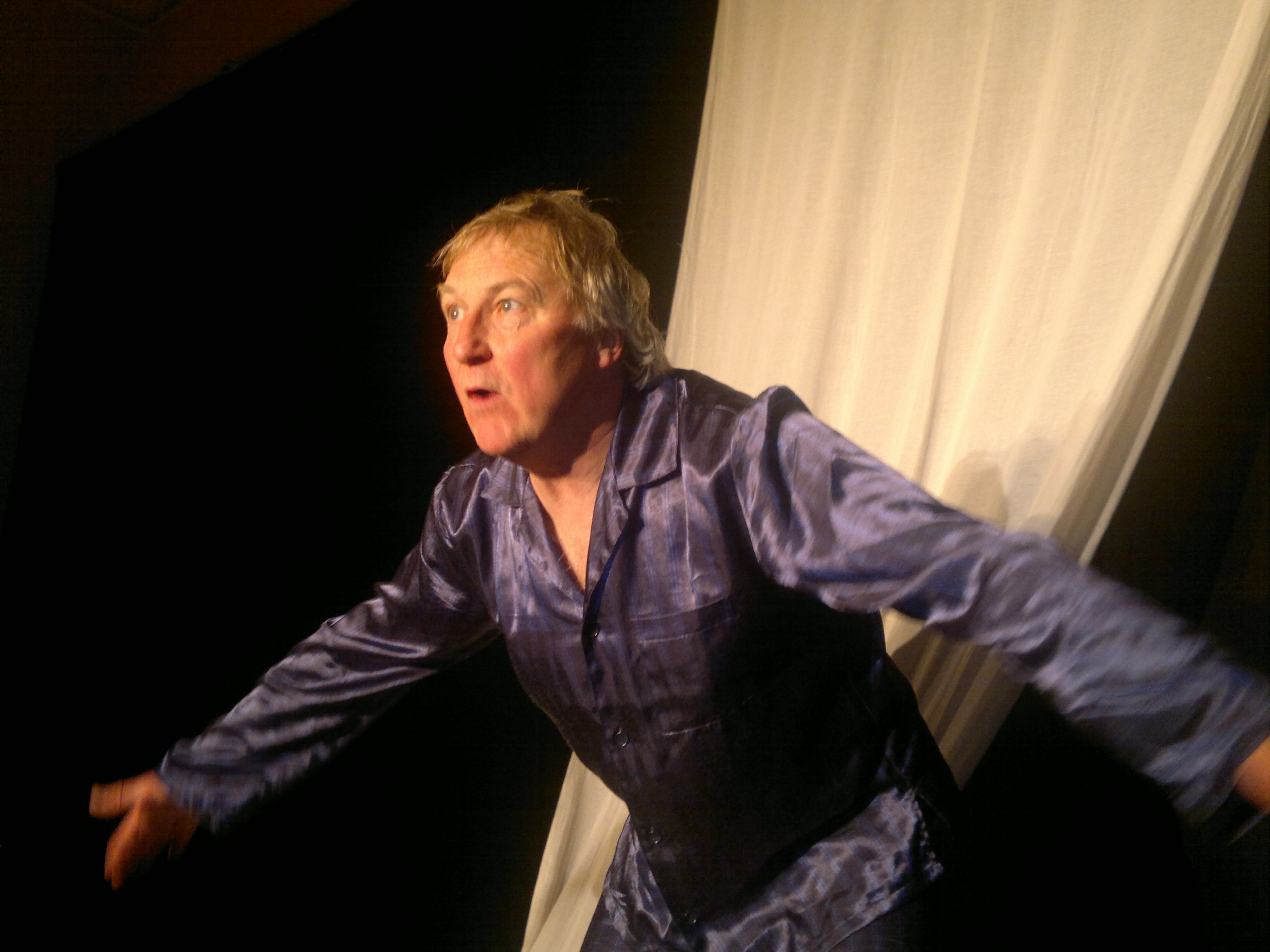
Catalpa, written and performed by Donal O’Kelly, tells the story of the 1876 rescue of six Irish prisoners from the Freemantle colony in Australia on a whaling ship captained by Capt. George Anthony. Simply set with a long white sheet suspended in the centre of the stage, draped over a box being the only set pieces (excepting Knight’s keyboard and equipment), the emphasis is on the storytelling throughout the piece. This was a good move as O’Kelly demonstrates a true talent for telling a rollicking good tale. Switching between characters adeptly, creating clear images of every person in the audience’s minds, O’Kelly draws us into the tale; I found myself leaning forward in my seat, flinching, laughing, holding my breath, frowning, grinning and smiling with each twist and turn in the story. The sheet is used to great effect to compliment this, becoming waves, an old mother-in-law’s shawl, a wife’s scarlet dress, and bedclothes, amongst other things.

O’Kelly’s performance is accompanied live by Trevor Knight who ekes brilliance out of the keyboard, bringing the sea, whales and many other parts of the story to life through sounds and music. The lighting design, adapted for this tour by Ray Duffy, is simple yet stunning. It captured every mood in the piece, transformed O’Kelly’s appearance from character to character and further brings to life the captivating tale.

Having been on the go since it premiered 20 years ago, Catalpa has probably clocked up more miles than the original ship, touring numerous Irish venues, travelling to the 1996 Edinburgh Fringe Festival (where it earned itself a first), and to myriad other international engagements from the Chicago Humanities Festival to the Harare Festival of the Arts Zimbabwe. It has deserved the run it has had and the status it has earned as a classic of contemporary Irish theatre; this show is an example of one of my favourite types of theatre. An engaging, exciting, funny and moving piece, Catalpa is intimate, enthusiastic, uncomplicated storytelling at its finest.

“Riverrun”- Review

Project Arts Centre

29/1/15

Riverrun-Theatre-Event-at-Project-Arts-Centre

I surprised myself by loving Olwen Fouéré’s Riverrun; had someone described the piece to me I would have been sceptical. A flowing stream of interlinking sense and senselessness, the script and Fouéré’s delivery of it was both natural, distinctly unsettling and peculiar. The simple set, with white powder or sand scattered along a curved path echoing the banks of a river, and the incorporation of the microphone, stand and lead into this created a simple yet atmospheric image that complimented but never distracted from the raw beauty of Fouéré’s words and performance.

This piece surrounds the senses, with the words filtering through the consciousness swimming between brief moments of clarity and of dancing, flowing confusion, the underlying sounds of the river and the simple yet powerful lighting complimenting the tone of the script. Riverrun is a captivatingly beautiful and intriguing piece that interests and delights throughout.

Review – Dublin Oldschool

Dublin Oldschool

Project Arts Centre

13/12/14

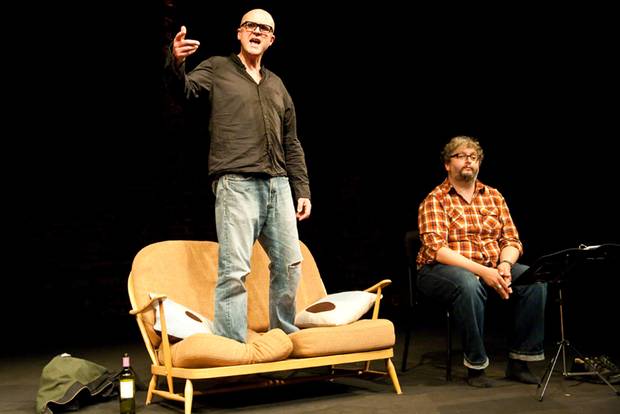
IMG_2015-0       This production, written by Emmet Kirwan and directed by Philip McMahon, is a fresh, dynamic, entertaining and powerful piece of theatre. I was caught as soon as Kirwan and Anderson entered, torches shining across the auditorium, immediately and crucially breaking the anticipated boundary between performer and audience. I must admit that, directly following that, my heart sank as Kirwan began to rap. I don’t like rap, or at least I didn’t think I did. However, within moments Kirwan had changed my mind. It showed the link between rap and poetry that I have always found it difficult to reconcile.

          This strong beginning was maintained with a fast paced combination of narration and acted scenes. The transitions between narration and dialogue, between rap and natural speech, and between humour and hard-hitting reality were seamless. This was further complimented by the well developed, realistic characters and recognisable settings. Anyone who has walked around Dublin at night can picture these characters beyond the theatre space and into real life. This was down to a mix of skilled writing and excellent delivery from both actors.

          I now wish to return to the combination of comedy and shocking truths I mentioned earlier. Though I and the rest of the audience laughed regularly throughout the piece, it was, at its core, a very hard-hitting, stark piece. The audience were laughing away one moment (though quite often ruefully) the would suddenly be silenced the next by a single line, a single image of the cruel, destructive reality of “the sesh” that Jason and Daniel live on. This was very powerful as the comedy drew the audience in and caught their attention for the more serious moments

          In terms of design, the lighting of the performers on the bare stage was simple yet stunning. Sarah Jane Shiels’ lighting design managed to capture the feeling of the piece without ever over complicating itself.

         In short, this production was, and I don’t use this phrase lightly, a tour-de-force. One of the most naturalistic and truthful yet somehow highly stylised pieces of theatre I have seen, Dublin Oldschool is a powerful snapshot into the world of “the buzz,” that should be seen by everyone that it can possibly be brought to.

Review – Hamlet

Just Friends Theatre Collective

Smock Alley

12/12/14Hamlet

This production directed by Aisling Smith with Just Friends Theatre Company, was the second Hamlet I have seen this year and it couldn’t have been more different from the first. Where Ostermier’s porduction with Berlin’s Schaubuhne was a loud, large scale production that tried to shock the audience at every turn, Smith’s Hamlet was a relaxed, engaging and accessible piece. The costuming and setting was unusual with modern dress being worn and the various levels of the Boy’s School space being used to great effect. However, apart from these and the paring back of the script, this was a show that was primarily concerned with telling the audience the enduring story of Hamlet.

For the most part, the performances were very competent, with Rory Doherty finding the balance between Hamlet’s mask of madness and his determination to discover and act upon the true facts of his father’s death, Michael Mullen and Lauren McGarry playing Rosencrantz and Guildenstern as a young couple and engaging performances from a host of other characters, especially Horatio and Marcellus played by Colm Kenny-Vaughan and Jimmy Kavanagh.

In terms of design, there were some beautiful moments of lighting by Paraic McLean, particularly the final tableau and the lighting of the ghost. Unfortunately due to the placing of the ghost in an archway behind the audience only certain portions of the audience could fully see the striking image. The sound design was unfortunately not as effective as it drowned out certain lines and did not add much to the piece overall.

In terms of direction, the production was overall very good, with only one scene that jarred with the rest of the play. The death of Polonius verged on pantomimic in its execution and detracted somewhat from the drama of the moment. More precision and subtlety would have made this scene much more effective.

Overall, this production of Hamlet was an entertaining and engaging evening’s theatre and I am interested to see more work from Just Friends Theatre Collective.

Review – “Our Few and Evil Days”

“Our Few and Evil Days”
Abbey Theatre
23/10/2014

IMG_1569.JPG

“It will rip something inside you and stitch it back together, but not in the same way, snatch your breath.”

This was the reaction a friend gave when I tweeted that I would be seeing the Abbey Theatre’s production of “Our Few and Evil Days” written and directed by Mark O’Rowe, and she was right. This was a stunning production that indeed snatched my breath, inhabited every part of my mind, made me both laugh and cry, and left me reeling as I left the auditorium. There are few shows that have that powerful pause between the final blackout and the applause as the audience absorbs what they just experienced and readjust to real life, but this was one of them.

The combination of O’Rowe’s skilled writing and the powerful performances delivered onstage, particularly by Ciarán Hinds and Sinead Cusack, made this piece an exciting, amusing and heart-wrenching experience. Every part of the performances and writing played a part in building the story of this family. The nuances, tone and progression of every conversation were intensely realistic, with each interruption and pause timed and delivered exactly, but with a powerfully natural feel. This was further complimented by the small devices in characterization, such as Hinds’ regular exclamations of “Jesus!” and Cusack’s slow, almost tired speech which portrayed important parts of the characters and story on an almost unconscious level.

These performances were strengthened by the excellent design of the stage and lighting. Particularly effective were the blackouts at the ends of scenes which served to build tension and to leave things unsaid that were more potent in their absence than if they had been said. These blackouts were especially effective when contrasted with the well designed, realistic lighting throughout the rest of the production.

Finally, I wish to comment on one particular moment which was not central to the plot and could in fact have easily gone unnoticed; I don’t even know if it was intentional. At this point in the play, Hinds’ character was standing at the kitchen sink which had a window above it when the rumble of the Luas passing made its way into the auditorium. Rather than just ignoring it, as is usually done, Hinds’ briefly looked out of the window, as if to acknowledge the passing of the Luas. My pet hate with the Abbey is the sound of the Luas reverberating through the auditorium, breaking the atmosphere momentarily so I absolutely loved this incorporation of it into the production. Whether purposely timed to coincide with the Luas, or just a fortuitous coincidence, this was a gem of a moment.

It may seem that I gave a disproportionately large amount of text to that particular moment, but it is significant as it is an example of the many small but powerful devices used within the production that gave it its overall strength and impact. Every aspect of the production combined perfectly to create a visually stunning, emotionally striking and utterly incredible theatrical experience.

Review – what happens to the hope at the end of the evening

what happensaa

Peacock Theatre.

Dublin Theatre Festival 4/10/2014

This gem of a piece directed by Karl James and performed by Tim Crouch and Andy Smith was a perfect way to spend a Saturday afternoon. From the moment Smith walked through the auditorium, sat in his chair and began to speak, I knew I was going to enjoy the show.

Telling the story of an evening between two long time friends who have been apart for some years, the piece examines the changes in each of their lives, the changes in their friendship and in the way they communicate. In doing this, light is also thrown on how we communicate, on how we are present in a space with other people. This was an interesting idea told through a compelling story.

Crouch and Smith delivered top-notch performances. Smith moved between narration and acing out scenes seamlessly and Crouch brought the character of his friend who has lost direction, who hasn’t moved on like Smith’s character, to life with expertise. The two actors bring the characters credibly to life while still maintaining interesting stylistic techniques such as talking to and looking out towards the audience and only rarely looking at each other. These devices are very effectively used to convey the traits of each character; Crouch’s character in his own world, looking beyond the audience and Smith’s more settled, talking to the audience and acting as a bridge between the characters and audience.

The tale of these men’s friendship, of the evening they spend together and the many past spent is further reinforced by moments such as those when Smith asks the audience to shake hands with each other and asks them to take off their shoes. As well as drawing the audience further into the story, these features served to strengthen the ideas of presence and togetherness that were central to the piece.

In terms of design this was a simple piece. However, the fully lit set changes carried out by Crouch were, like every other aspect of the piece, very effective in maintaining and developing the tone of the piece. They meant that the audience was never torn out of the story by a blackout; there was a flow to the piece that gave it a very natural feel despite the unnatural devices such as the positioning of the actors’ gazes.

In short, this piece was a powerful and compelling yet comfortable piece of theatre that drew the audience in from the start and delivered a captivating narrative with startlingly real characters and a potent message.

Review – “Adishatz/Adieu”

Project Arts Centre

Dublin Theatre Festival 3/10/14

My trip to see Jonathan Capdevielle’s “Adiashatz Adieu” at the Project Arts Centre was an impromptu one. I was offered a ticket a couple of hours before the show and accepted without really knowing what the piece was; I had no time to research it and my notes were taken on the back of the programme because I didn’t have my notebook with me. However, this piece was so different, so fresh that I think that even had I had the chance to know more about it before I saw it, it would still have produced the same responses, the same unsettlement and the same questions.

The show began with Capedeville, dressed unassumingly, holding a mic in one hand and a can of Pepsi in the other standing in the centre of the stage projecting a nervous air towards his audience. This feeling of testing the waters continued as he broke into an a cappella Madonna medley, pausing between each song, hand in his pocket, closed off; but soon we could feel him find his feet as the strength of each song grew and he began to show off his vocal abilities.

From the Madonna medleys Capedeville moved to much more shocking, harrowing songs in French (with surtitles). This gave us an idea of what was to come as the show progressed. Following these songs Capedeville quickly moved into playing out scenes from real life; a stilted conversation with his father, a distressing scene in a hospital with an ill relative and an all too familiar scene of drunken antics outside a nightclub.

Capedeville portrayed these scenes with great skill, switching between characters vocally with ease and distinction. Midway through these scenes he also changed character in terms of costume, switching into drag at a dressing table upstage. The onstage costume change complimented the raw, pared down feeling of the piece. There was no flashy fantasy in this; it was a bare snapshot into Capedeville’s mind.

The performance was further strengthened and complimented by the excellent lighting by Patrick Riou. Riou kept the lighting simple in terms of colour and used effects sparingly so that when they were used, they had a real power. From the beautiful yet unsettling reflections from the mirror ball to the spotlight which created the powerful separation between Capedeville and the other singers; the lighting was superb.

I only have one minor complaint and that is to do with the surtitles. Generally they were very good, but I found there to be some inconsistency in translation at some points. There were some parts in French that were not surtitled and consequently would have been lost on any members of the audience who did not understand French. This is, I think, a pity as they were no less important than any other lines.

Without a doubt, this was an unsettling piece. I know that during it I hardly knew what to think or how to react and judging from the occasional moments of uncertain laughter from the audience; I doubt I was the only one that felt that way. However, this unease felt intentional and I think it worked with the piece. This, for me, was something truly new and different. I was left thinking and reflecting upon it for some time after I left the theatre behind.

Review – “Hamlet”

Schaubuhne-Hamlet

Berlin Schaubühne
Bórd Gáis Energy Theatre
Dublin Theatre Festival 25/9/2014

Berlin Schaubühne’s production of “Hamlet” came highly recommended to me; however I sadly cannot pass that recommendation any further. This production, directed by Thomas Ostermeier has been generally very well received but, though elements of it were very impressive, I was disappointed with it overall.

The show opened with a striking dumb show at the burial of Hamlet’s father. This very impressive visual scene with no dialogue did, in a way, set the tone for the rest of the piece. However, I must say that I found this opening scene, with the dark, shadowy pre-set, the slapstick antics of the gravedigger, the stony faces of the other characters, the ever building music and the tension this all created, to be the high point of the production.

After this scene, there was a return in the direction of the original script with the celebrations of Gertrude and Claudius’ marriage and Claudius’ ascension to the throne. I on the other hand was not celebrating as this scene marked the introduction of the radio microphone which was quickly to become very much overused. There were points at which it was a powerful dramatic tool, such as in the appearance of the ghost, but for the most part it felt like a gimmick. This can also be said for the live video feed that was used regularly throughout. There were many devices like these that began very quickly to bring the production down. The worst of them was without a doubt when Hamlet (played by Lars Eidinger whose performance was for the most part very good) broke the fourth wall and began to interact with the audience in English. He had a moment where he introduced a DJ-like persona to his character and another where when audience members left the auditorium during the performance he called out to them, stopped them and questioned them on why they were leaving. This was unnecessary and irritating as it broke the flow of the piece without any real reason or benefit and came over as nothing but a blundering attempt at alienation.

Elements like these dominated the production and it seemed to me that they sometimes overtook the plot in terms of importance in the eyes of Ostermeier. The story, on occasion, took a backseat in favour of attempting to shock the audience or provide a radical gesture. This, in my opinion, gave the whole production a contrived air that began to bore me as a spectator.

Despite these flaws, I must mention the excellent technical and musical features of the production. The set, designed by Jan Pappelbaum, was very well designed with an exact balance of versatility and aesthetics. This was complimented by the atmospheric and minutely detailed lighting design by Erich Schneider. Finally, as I mentioned before, the music in this production, composed by Nils Ostendorf, perfectly brought the emotions and action of the play to a new level of vitality.

I understand why the director did what he did in creating such madness on stage to mirror Hamlet’s insanity and throw a new perspective onto the play. The right idea was there and this production could have been brilliant. Indeed, it had many of the elements of a great production but it took them too far and added gratuitous action that seemed to serve no purpose but to shock the audience. Berlin Schaubühne’s “Hamlet” tried too hard, pushed its boundaries too far and consequently it unfortunately derailed itself.

Review – “The Rise and Fall of the City of Mahagonny”

app+MAHAGONNY+review

Rough Magic and Opera Theatre Company
The Olympia Theatre
22 June 2014

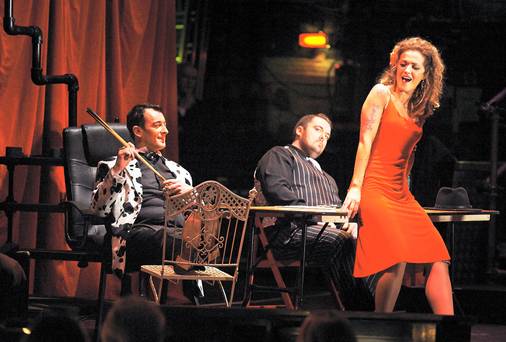
The City of Mahagonny, the city of decadence where anything goes except you. Written towards the end of the roaring twenties and premiered in Germany in 1930 in the midst of the Great Depression, this play by Brecht and Weill describes the rise and fall of capitalism and materialism through the imaginary city of Mahagonny and the story of Jimmy Mahony. Founded by a trio on the run from the law, Mahagonny is to be a city of pleasure and a city of debts from which they make their fortune. However, from the off, flaws show through in the plan and the arrival of four lumberjacks from Alaska, including Jimmy Mahony, sees the beginning of the end for this city where food, sex, boxing and drinking are the only way of life.
Somewhat like Mahagonny itself this production by Opera Theatre Company and Rough Magic was overall very enjoyable but sadly had some cracks that showed through, though thankfully not to the same extent as in Mahagonny!
The performances were mostly excellent, particularly by John Molloy as Trinity Moses, who perfectly captured the suave nastiness of his character and whose rich bass filled every corner of The Olympia. Claudia Boyle also delivered a very impressive performance as Jenny, bringing a great power to the character, both vocally and in terms of characterization. I did find however that Julian Hubbard lacked a similar power in his role as Jimmy, with some of his vocals lost to the orchestra, which was a pity as his overall portrayal of the character was promising.
The design by Aedín Cosgrove was generally very good. The re-configuration of the venue, with the orchestra where the left half of the stalls would be and the performers roaming the stalls, circle and the left boxes, was effective from where I was sitting (Row B in the stalls) and, I believe, from the stage seats. However, I doubt it was of much benefit to the audience in the upper circle and boxes. Apart from this, I found the whole production design very impressive, from the simple yet effective lighting to the set; Mahagonny was really brought to life.
The part of the production that, for me, raised the most questions was the final scene. The crucifixion of Jimmy (where in the text he is executed in the electric chair) left me questioning the director’s reasoning. Was it placing Jimmy as a sort of Messiah? If he was, we must question what he was a messiah for. He promoted greed, violence and materialism. Did the director, Lynne Parker, really believe his character deserved the symbolism of the crucifixion or was she simply looking for an easy striking image? Whichever it was, it needed more to explain it.
I think that, like the plans of Begbick, Moses and Fatty, this production seemed promising but fell short in its execution. It was a daring and ambitious project but one that unfortunately did not live up to the ideas of its creators.