Cascando – Review

Pan Pan Theatre

Beckett Theatre

23/04/16

cascando pic

When I think of the words “radio play,” it is generally in conjunction with an image of the listener pottering around the kitchen, or perhaps curled up in a chair. This is evidently not the same for Pan Pan’s Gavin Quinn, who’s installation of Beckett’s Cascando is an unsettling, absorbing and intriguing journey through a reflective maze, both in terms of set and text.

First broadcast in October 1963, Cascando is a play for music and voice that circles around and overlaps itself in a short but potent exploration of sound, silence, language, identity, journey and storytelling. As the audience walks around Aedín Cosgrove’s labyrinthine, mirrored set, clothed in long hooded robes listening to the play through headphones, there is an odd combination of connectedness and isolation, playing with the disjointed flow of the text between Voice and Music. With only a few lights around the labyrinth, one’s eyes never quite adjust to the darkness, just as one can never quite adjust to the text. Just as Voice seems settled, the Opener calls a halt, and introduces the discordant and intense Music. This constant cycling and overlapping of Voice and Music, like the changing levels of light, means the listener is always alert, awake to both change and repetition.

Walking around the space, moving slowly towards a centre circle, catching glimpses of people through walls, with reflections and reality blurred, this is a truly immersive experience. As the audience slowly makes its way through the darkness, pausing at corners, unsure what is mirror and what is open space, cautious of bumping into each other, changing pace with the light and the text, one truly experiences the vacillating, uncertain journey of Woburn in this deeply immersive, yet personal and detached installation of Beckett’s Cascando.
Taboo – Review

Taboopic

The New Theatre

16/02/16

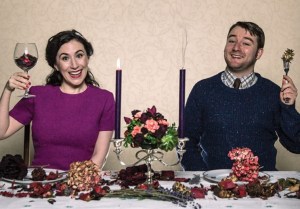
Taboo, written by John Morton and directed by Sarah Baxter can best be described as provoking a “yes, but, no, but” reaction. Well performed and directed, this play had good potential and many positive features, but fell sadly short in terms of script.

Both Morton and Fox, under Baxter’s laudable direction, give engaging turns as Tom and Lily. Opening the show, Fox demonstrates excellent comic timing and ability to quickly switch characters as she rehearses nervously for her impending date with Tom. Morton bounces of this agitated energy effectively, bringing a good balance of character to the stage. The two performers maintain this quality of performance throughout, despite having to contend with an unwieldy script.

Morton’s writing displays an strong aptitude for character-writing, and for natural, light dialogue. However there were issues with the construction of the story; rather than following a clear, smooth arc, the story felt more as though it was following two lines that were lightly joined together. The switch in tone mid-way through the piece came across as abrupt and awkward. Though there had been hints that all was not as it seemed in the earlier scenes, there was too heavy-handed an introduction of darker elements later in the play for this to balance with the light comedy of the start. In addition to this, the script would benefit from generous editing in places. At times, such as one particular scene in which the characters discuss urban legends, the dialogue and action dragged, losing the audience’s attention.

With an interesting and entertaining root idea, Taboo takes an almost-there script and puts it on stage with skill and vivacity.

Taboo runs at The New Theatre until 27th February.


Trainspotting -Review

Smock Alley Theatre

4/2/16


trainspottingpic

Renton doesn’t choose life. Renton chooses “something else.” Tracing the interlocking stories of a group of friends, acquaintances, “associates,” whose lives have been ravaged by heroin, Trainspotting is a sharp, painfully funny and agonisingly heartbreaking piece.

From the off the cast bring an impressive energy and passion to the performance, with Shane O’Regan once again showing his skill and versatility as an actor, delivering a vivid, raw turn as Renton.  O’Regan captures the multi-faceted nature of the character; he is not just “a junkie,” he is a character that has a burning vitality and story around him. As well as portraying the intensity of Renton, O’Regan has a particular skill for quick quips, delivering sharp laughs and gags with a perfectly measured but naturalistic style. Lórcan Strain’s performance as Tommy was also impressive, capturing the changing situation impressively. The entire cast caught the essence of their characters, however, in the case of Foley and Healy there were moments at which this was masked by dubious Edinburgh accents. Inaccurate accents, laid on too thickly resulted in lines being lost.

Noteworthy in terms of Tracy Ryan’s direction is her use of the all too often neglected upper levels of the Boy’s School giving a powerfully immersive feeling to the piece. Ryan allows the audience to take in many aspects of the characters and situation by having the characters engage directly with them, breaking down the distance created by more traditional staging.

Adding to this immersive feeling, Brian Murray’s lighting design, with its initial club atmosphere, right through to moments of intense use of shadow, was a particularly strong feature of the production. Once again, the clever use of the space available was evident in the design.

The whole production was well-constructed to truly draw the audience into the characters’ story, to the extent that at one point when a number of characters are chanting for another to jump dangerously from a height, members of the audience were so caught up in the atmosphere that they joined in the chant before realising what they were doing and stopping.  This is a good indicator of just how engaging and powerful this production is.

Trainspotting is not an easy play to watch, it demands engagement both in terms of your attention and your emotions, but it is a great play to watch. I came out of the auditorium well and truly phased by the intensity of the production; it didn’t feel like watching characters, it felt like watching people, and that is what makes Trainspotting an entertaining but stomach-turning and heart-wrenching piece of theatre.


Trainspotting runs until February 13th


Spandex Blues – Review

Smock Alley

27/1/16

CW2BMu-WUAAfLDK.jpg large

If you thought sibling rivalry was a problem in your family, you have nothing on E, Dublin’s greatest super-villain, youngest member of Dublin’s greatest superhero family. Written by Diane Crotty and directed by David Doyle, Spandex Blues is the simple but royally entertaining story of E, super-villain and little sister.

Both performers, Diane Crotty as E and Luke Casserly as Henchie, deliver engaging and enthusiastic performances. Crotty brings a great balance to her role, prompting gales of laughter throughout, while still conveying the more serious elements of her story with a touching sincerity. Her fluctuation in tone kept the piece moving apace and never let the energy burn out or flag. The cast also managed audience participation admirably, effectively moving what was a rather nervous audience to a point where they were willing to join Casserly in singing the Mission Impossible theme tune.

The design is simple and, for the most part, effective. The pre-set, with a video of various locations around Dublin city projected onto a white-board and surrounded by planning diagrams immediately framed the setting while also showing that it was not entirely the usual Dublin city. The lighting design has a few minor issues, with too much shadow falling on the actors’ faces at times, though that was also a case of the actors not always finding their light. That is, however, a small complaint about what was, overall a very entertaining piece of theatre.

Spandex Blues will make you both laugh out loud and pause to think, and most of all it will transform your view of the number 16 bus through Drumcondra forever.

Microdisney – Review

microdisney

The New Theatre

18/1/15

Neil Flynn’s Microdisney is an entertaining but thoroughly heartbreaking piece of theatre. Having escaped from an institution or psychiatric hospital and her “woman,” Clodagh Corona explores her hometown of Tralee for the first time in years. As she traverses the town, she gradually shares the story of how she came to be admitted when she was only eight years old. Sitting on her “island” in the middle of the town she tells the story of the fateful day Geraghty brought her “back the tide.”

Judith Ryan delivers an impressive performance as Clodagh, bringing a potent energy and physicality to the performance.  Though only a snapshot of Clodagh’s life is presented, it is evident that she is a complex character, and Ryan brings all of the influences on her character and behaviour together to create a strong, engaging and heart-achingly real character on the stage. Working excellently with the fluctuations in intensity and emotion in the script, Ryan keeps the audience captured in the story from start to finish.

Flynn’s script is a clever blend of poetry and natural speech that patters along apace, meaning that when Ryan pauses, the moments of silence are as powerful as the words in conveying Clodagh’s experiences. The ballet scene is a moving and striking interlude in Clodagh’s story, though a smoother transition from speech to music would have made it even stronger.  Also deserving of a mention with particular regard to this scene is the lighting design by Cathy O’Carroll. Though simple, the design really comes into its own in this scene as the shadows from the floor lights dance with Clodagh.

Microdisney is a moving and engaging work that tells an all-too heartbreakingly recognisable tale (versions of which were experienced by many women across the country) with sensitivity and passion.

Microdisney runs at The New Theatre until 23rd Jan before touring.

The Importance of Being Earnest – Review

15_The_Importance_of_Being_Earnest

Gate Theatre

16/01/16

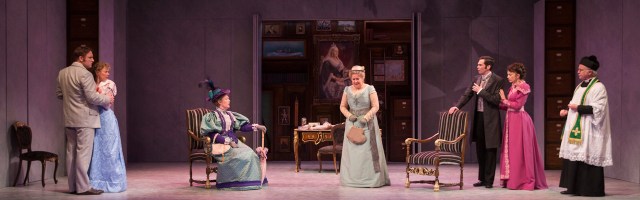
Although it was first staged just short of 121 years ago, Wilde’s The Importance of Being Earnest, still feels fresh and, well, earnest. Even in reading the text, the vigour with which each character lives their lives is infectious; in performance it becomes a feast of vivacious madcap antics. Earnest fits the style of the Gate theatre perfectly, and Patrick Mason does a superb job with it.

Marty Rea’s acting has always impressed me, but in this production he truly came into his own, revealing perfect comic timing and a flair for face-pulling akin to Danny Kaye. Of the three portrayals of the character of Jack Worthing I have seen, this is the only one that I feel does justice to the character.  The rest of the cast all deliver impressive performances, with every actor pulling their weight.  Particularly notable were Lisa Dwyer Hogg and Lorna Quinn making the perfect duo as Gwendolen and Cecily, bouncing the energy of the two characters back and forth with sharp but easy precision.

From here, I wish to turn to the set, designed by Francis O’Connor. Few sets can capture the tone of a piece and the nuances of the characters that inhabit each setting as well as O’Connor’s does. With a relatively bare pre-set, we have little clue as to how much the set is going to bring to the production (though the addition of an image of Wilde on the back wall was a clever and playful touch!). Soon however, the many surprises of the set are revealed as a whole host of sliding panels and extensions transform into the home of Algernon Moncrieff, with everything a well-to-do dandy could want, through a garden, to the home of Jack, the polar opposite of the foppish Algy.

Wilde himself described Earnest as “exquisitely trivial,” and that was certainly the feeling in the auditorium at the Gate. I regretted wearing eyeliner as tears of laughter streamed down my face; from polite titters to uproarious belly laughs, the room rippled almost constantly with a wave of collective laughter.  This production of The Importance of Being Earnest is a lively, smart and suitably irreverent evening of Wildean wit and frivolity.

The Importance of Being Earnest runs until 6th February 2016.


The Boys – Review

Smock Alley

18/11/15

12239664_1096620553684215_8669207894965992384_n

Written by Michael Harnett and directed by Patrick Sutton, The Boys tells the story of a group of teenage boys (or perhaps more appropriately, a gang of lads) from Drumcondra and the events of their Inter-cert year, 1967. Following the ups and downs of the year for each of the four boys, this play hits the highs with an infectiously heady optimism and hilarity and the lows with an equally catching poignancy and pain.

The four actors, all recent graduates from the Gaiety School of Acting, handle their roles with skill and energy, with both Killian Coyle as Hackett and Shane O’Regan as Brennan delivering particularly impressive performances. Each actor has a primary role of one of the boys but all take on the guises of parents, girlfriends and many other supporting characters when their anecdotes demand it.  With only small changes of costume, a wig here, a hat there, and simple changes of posture and voice the cast portrayed all of the characters of the boys’ Drumcondra of 1967 with clarity and vitality (with O’Regan’s caricature of the Belvedere College secretary being a comic highlight!)

The script was well composed, capturing the distinctly youthful manner of speech of the boys (I know, I’m not too far from their age myself!) as well as the phrases and nuances of the Drumcondra accent. The transitions from levity to seriousness were also very cleverly written, always flowing naturally, catching the audience in a moment between laughter and tears.

The Boys is a recognisable, sometimes all-too real, tale of growing up, with all of its antics, heartaches and changes that will have a laugh and a tear competing in your throat.

King Lear – Review

Mill Productions

Mill Theatre Dundrum

13/10/15

 king-lear-001

King Lear is my favourite Shakespeare play and consequently I automatically set high standards for any production of it, but Mill Productions’ take on King Lear did not disappoint.

From the opening the lighting stood out, with Kris Mooney’s design capturing the atmosphere and heightening the emotion in every scene perfectly. This was particularly so in the final tableaux with Lear, Cordelia and Edgar which was visually stunning.  Another interesting aspect of the lighting was the engagement with shadows, particularly by the Fool, which added another level of effective visual expression to the production.

Lenny Hayden as Lear and Shane O’Regan as the Fool both delivered impressive performances. Both handled the language with dexterity and worked excellently together as a pair. O’Regan captured the balance between eccentricity and wisdom in the Fool effectively. The rest of the cast all delivered competent and engaging performances, though Paul Elliot as Edmund did at points over-act, with too much shouting and high tension performance at times where it was not necessary.

The opening scene, with the Fool scampering in and starting a dynamic movement scene was an intriguing and captivating one. However, it was not followed through in the piece, which I would like to have seen. Had there been a stronger thread of that movement through the piece, the opening would have gelled better with the play as a whole. As it was they seemed two disjointed pieces, both effective and engaging, but neither entirely connected to the other.

This production was an entertaining and evocative rendition of Shakespeare’s tragic tale. In its engagement with the characters and its attention to the smaller details, Mill Productions truly brought Lear to life.

Review – Luck Just Kissed You Hello

Dublin Theatre Festival

Project Arts Centre

02/10/15

LuckJustKissedYouHello

Big Ted is dying and Sullivan, Gary and Mark have come together to make final arrangements and farewells, but despite the constant beeping of hospital equipment in the background, this piece quickly reveals itself to be about much more than just the difficulties of composing a eulogy and making practical arrangements. Sullivan sees Ted as a father figure though he isn’t his biological son, Gary and Mark are estranged from Ted, their father, Gary is gay, Mark’s birth name was Laura; in short, there is a simmering tumult that the death of Ted is bringing to a head.

This tumult shines through in Conroy’s writing, with sharply insightful, carefully crafted dialogue running throughout the piece. This is punctuated with stirring and unsettling scenes of reminiscence that consume the stage and audience and envelop them in a chilling wave of memory and mis-memory. However, watching this piece I found there to be an imbalance of focus in the script between the characters. The writing (and partly direction) of the hierarchy of characters in this piece created too great of a division between the character of Mark (Amy Conroy) and those of Gary and Sullivan. Had the focus been somewhat more balanced, rather than being so strongly centred on Mark, each character, Mark included, could have brought more strength to the story.

In terms of design this performance was very impressive, with John Crudden’s lighting design deserving of particular mention. Aedín Cosgrove’s minimal set provided the perfect blank canvas for Crudden’s dynamic and evocative design.

Moving beyond the execution of this piece, Conroy’s treatment of the subject must be commended. Similarly to some of her other work, Luck Just Kissed You Hello brings subjects often swept under the carpet to the fore through a recognisable story or setting. In blending the story of the family and Big Ted with Mark’s experience of transition, Conroy makes both stories accessible and engaging.

With its blend of comedy, insight and harrowing truths, Luck Just Kissed You Hello is an exploration of family relationships, acceptance and identity that entertains and informs in equal measure.

Rebel Rebel – Review

Bewley’s Cafe Theatre

Tiger Dublin Fringe

08/09/15

Originally published on The Public Reviews

REBELREBEL-Showinabag-620x330

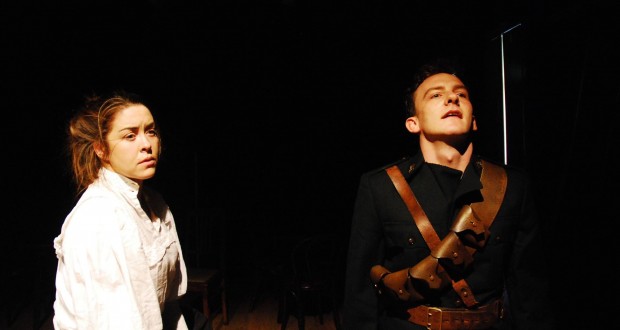
Rebel Rebel (part of this year’s Show in a Bag series) is an engaging and interesting snapshot of the 1916 Rising through the eyes of two of its participants, Helena Molony (Aisling O’Mara) and Sean Connolly (Robbie O’Connor).  With nothing but a table and chair in the centre of the room, O’Meara and O’Connor bring their characters’ experiences of the rising to the audience with a vitality and volatility that successfully captures the wider social climate of the time. The combination of the changes in tone, the fear they obviously feel, and the more mundane problems they face because of the rising; all combine to create a complex web of personal and national history.

Rebel Rebel is bookended by the a performance of W.B. Yeats’ seminal play Cathleen Ní  Houlihan which the characters abandon to march to Dublin Castle. This worked well, providing a structure to what is a very volatile, rapidly shifting play. However, the voice-over of lines from Cathleen Ní Houlihan detracted somewhat from the live performances as it competed with the central action of the performance, while not being easily understood itself either. The idea was a promising one; should the execution be polished it would be a very effective enhancement to the performance.

Rebel Rebel captures the idealism, and the violent and gritty reality, behind the rising, as, through Lowe’s direction, it presents snippets of the experiences of Molony and Connolly. This show is no light piece of lunchtime theatre; this show is a fast but penetrating flight through the Rising. With its gilt edges of idealism brought forward by the characters, and the threads of violence, loss and pain woven through their individual stories (and those of the Rising in general) Rebel Rebel is a compact but forceful picture of the 1916 Rising

thepublicreview_ver_print